
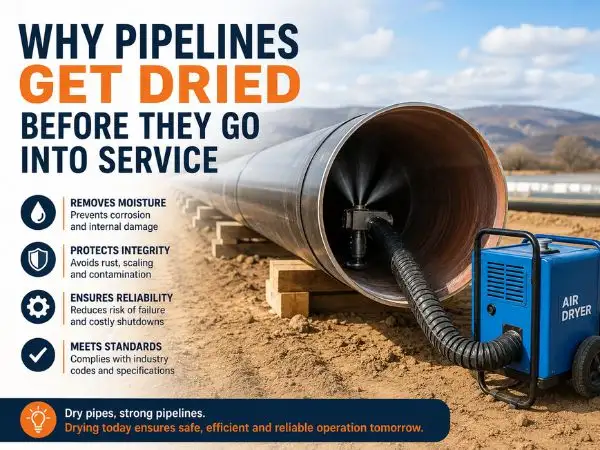
Most people never think about what happens inside a pipeline before oil, gas, or water starts flowing through it. But the steps between construction and that first delivery are where projects either run smoothly for years or run into expensive trouble. One of the quieter, less glamorous steps is drying the pipe out after it’s been pressure-tested with water.
It sounds simple. Push water in, push water out, done. In practice, it’s a careful process that protects the pipe, the product, and the people downstream.
Here’s a clear look at why pipeline drying matters and how operators handle it.
What hydrotesting leaves behind
Before a new pipeline is approved for service, it gets hydrostatically tested. Crews fill the line with water and pressurize it well above normal operating levels to confirm that welds, joints, and the pipe wall itself can handle the load. It’s the industry’s standard way of proving a line is safe, and regulators in most jurisdictions require it.
The catch is that once the test passes, the pipeline is full of water. Gravity drains and pigs can clear out most of it, but a thin film of moisture clings to the inside surface. That residual water is the problem the drying process is built to solve.
Why leftover water is a real problem
A wet pipe might not sound dangerous, but moisture inside a hydrocarbon line causes a chain of issues that show up weeks, months, or years later. Operators dry pipelines for a few specific reasons:
- Corrosion. Water plus oxygen plus steel equals rust. Internal corrosion shortens the life of a pipeline and creates leak risks that are expensive to find and harder to fix once the line is buried.
- Hydrate formation. In natural gas service, water and gas can combine under pressure to form solid hydrates. These ice-like plugs block flow, damage equipment, and are a known cause of unplanned shutdowns.
- Product contamination. Lines carrying refined fuels, chemicals, or specialty gases can’t tolerate water mixing in with the product. Even small amounts throw off specifications.
- Freezing. Pipelines in cold climates can freeze at low points if water isn’t removed, which damages the pipe and any instrumentation tied to it.
Federal regulators oversee the safety side of all this, and the cost of getting it wrong, in fines and in incidents, is the reason operators take drying seriously.
The main drying methods
There’s no single right way to dry a pipeline. The method depends on the line’s length, diameter, geometry, the product it will carry, and how dry the pipe needs to be before commissioning. A short water line going back into municipal service has a much looser spec than a long-haul natural gas line.
- Pigging. Specially shaped foam or polyurethane pigs are pushed through the line to scrape and squeegee out bulk water. It’s usually the first step, not the final one.
- Air drying. Dry, compressed air is blown through the pipeline until the moisture content drops to the target dew point. It’s cost-effective for many lines but takes time.
- Vacuum drying. Pressure inside the pipe is dropped low enough that residual water boils off at ambient temperature. It works well for large-diameter lines where blowing air through would be slow and expensive.
- Nitrogen drying. Dry nitrogen displaces moisture and, because it’s inert, eliminates the oxygen that drives corrosion. It’s a common choice for gas pipelines and any service where leaving an oxygen-free atmosphere in the pipe is a plus.
- Glycol swabbing. Methanol or MEG is run through the line between pigs to absorb the last traces of water. Often used in combination with one of the methods above.
Choosing the right approach
Picking a drying method isn’t only about cost. Schedule, target dew point, environmental rules, and the next step in commissioning all play into it. A line that needs a dew point of minus 40 degrees, for example, can’t realistically get there with ambient air alone.
This is where specialized contractors come in. Operators often turn to providers of pipeline drying services that bring the nitrogen generators, compressors, dryers, and monitoring gear needed to hit a specific dew point on a specific schedule. For most operators, it’s faster and cheaper to bring in that expertise than to try to assemble the equipment in-house.
The right contractor will also document the work, which matters when regulators or downstream customers ask for proof that the line was dried to spec. Nitrogen, in particular, gets used because it does double duty as a drying medium and a long-term preservation gas if the line will sit before going into service.
A small step that protects a big investment
Pipelines are multi-million-dollar assets meant to run for decades. Industry standards covering construction, testing, and commissioning exist precisely because the cost of skipping a step is so high. Drying sits at the end of construction but at the start of everything that comes after.
It’s the kind of work that’s invisible when it’s done well. No corrosion problems years down the road, no hydrate plugs in winter, no off-spec product showing up at the terminal. For project managers and operators, the takeaway is straightforward: budget for it, plan for it, and bring in people who do it for a living.
