
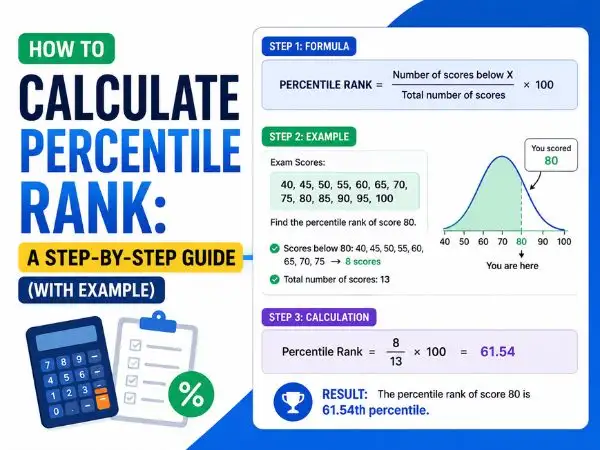
Whether you are analyzing test scores, evaluating survey data, or measuring performance metrics, understanding percentile rank is an essential data skill. It tells you exactly how a specific score compares to the rest of a group.
While the concept sounds highly technical, calculating it is actually quite straightforward once you know the steps. Here is your complete guide to understanding and calculating percentile rank.
What is Percentile Rank?
Percentile rank indicates the percentage of scores in a distribution that fall below a specific value.
For example, if you score in the 85th percentile on a standardized test, it does not mean you scored 85% on the exam itself. Instead, it means you scored higher than 85% of the other people who took the same test. It is a measure of relative standing, not an absolute score.
The Percentile Rank Formula
To find the percentile rank, you need to know the total number of values in your dataset and how many of those values fall below the specific score you are measuring.
$$PR = \left( \frac{B}{N} \right) \times 100$$
Here is the breakdown of the variables:
- PR: The Percentile Rank you are trying to find.
- B: The total number of scores strictly below your target score.
- N: The total number of scores in the entire dataset.
Step-by-Step Calculation Guide
Calculating the percentile rank manually takes three simple steps.
- Organize your data: Arrange all the numbers in your dataset in ascending order, from the smallest value to the largest.
- Count the lower scores: Identify the target score you want to analyze, and count exactly how many values in the list are smaller than that number.
- Apply the formula: Divide the number of lower scores by the total number of scores, and multiply the result by 100. Round to the nearest whole number.
Real-World Example
Let’s say you manage a sales team of 10 people, and you want to find the percentile rank for an employee who closed 42 deals this month.
First, we need the total dataset of closed deals for all 10 employees.
| Employee | Deals Closed |
| Alex | 12 |
| Sam | 18 |
| Jordan | 25 |
| Taylor | 31 |
| Casey | 38 |
| Morgan (Target) | 42 |
| Riley | 45 |
| Jamie | 51 |
| Drew | 58 |
| Avery | 63 |
Applying the steps to Morgan’s score:
- Organize: The table above is already sorted from lowest to highest.
- Count lower scores (B): There are 5 scores below Morgan’s score of 42 (12, 18, 25, 31, and 38). So, B = 5.
- Total scores (N): There are 10 employees total. So, N = 10.
Now, plug these numbers into the formula:
$$PR = \left( \frac{5}{10} \right) \times 100$$
$$PR = 0.5 \times 100$$
$$PR = 50$$
The Result: Morgan is in the 50th percentile for sales this month. This means Morgan closed more deals than 50% of the team.
Also Read : – How to Become a Doctor in the USA from India After 12th (Ultimate Guide)
Percentage vs. Percentile: What is the Difference?
People often confuse percentages and percentiles, but they measure two completely different things in statistics.
- Percentage: An absolute metric that measures a part out of a whole (e.g., getting 80 out of 100 questions right means you scored 80%).
- Percentile: A comparative metric that measures how a score relates to a broader group (e.g., scoring higher than 90% of the class means you are in the 90th percentile, regardless of your actual percentage grade).
Frequently Asked Questions (FAQ)
What happens if there are duplicate scores (ties) in the dataset?
For basic calculations, you still only count the number of scores that are strictly lower than the target score. However, if you want a more precise statistical measurement (often used in software like Excel), you add half of the tied scores to your “below” count. The modified formula looks like this:
$$PR = \left( \frac{B + 0.5E}{N} \right) \times 100$$
Here, $E$ represents the number of times that exact score appears in the dataset.Can a percentile rank be exactly 0 or 100?
You can have a percentile rank of 0 if you have the absolute lowest score in the dataset (because zero people scored lower than you). However, using the standard formula, you cannot reach exactly the 100th percentile. This is because you cannot score strictly higher than yourself. In a group of 100 people, the absolute highest score would be in the 99th percentile (scoring higher than 99 out of 100 people).
What does the 50th percentile mean?
The 50th percentile represents the exact middle point of your dataset. In statistics, this is called the median. If you score in the 50th percentile, exactly half of the group scored below you, and half scored above you.
How do I find the score if I already know the percentile?
If you want to reverse the process—meaning you know the percentile and want to find the corresponding score in your dataset—you calculate the position (rank) of that score using this formula:
$$R = \frac{P}{100} \times (N + 1)$$
R: The position in the ordered list
P: The target percentile
N: Total number of items in the dataset
If $R$ results in a decimal (like 4.5), the target score falls exactly halfway between the 4th and 5th numbers in your sorted list.
