
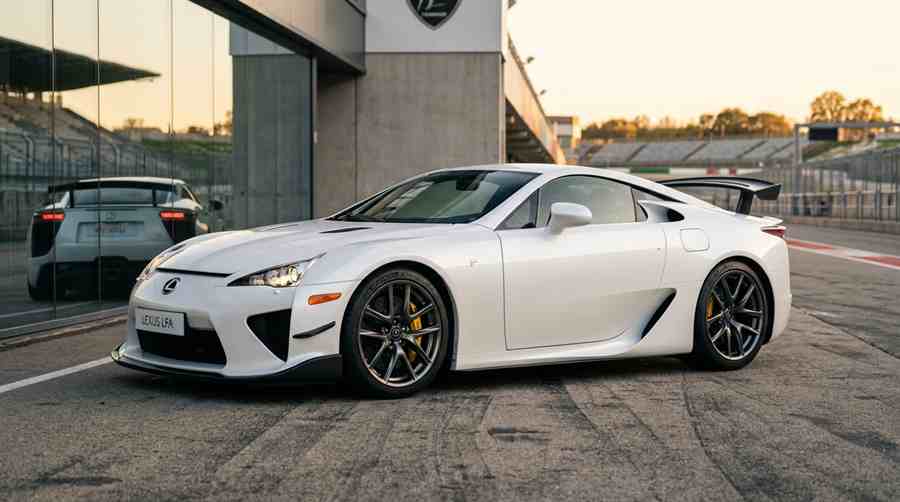
The Lexus LFA is so expensive because Toyota capped global production strictly at 500 units, constructed a revolutionary 65% Carbon Fiber Reinforced Polymer (CFRP) chassis on a circular laser loom, and engineered an acoustically tuned 4.8L naturally aspirated V10 with Yamaha. Originally introduced in 2011 with a manufacturer’s sticker price of \$375,000, secondary market appreciation has propelled transaction values between \$850,000 for base variants and over \$1.6 million for the 64 track-focused Nürburgring Package editions.
Toyota lost money on every single production chassis because its decade-long development cycle famously threw away five years of completed aluminum tooling to pioneer bespoke automated carbon weaving. As modern automotive regulations permanently retire high-revving naturally aspirated multi-cylinder engines, collectors view the LFA as an irreplaceable mechanical benchmark of the analog supercar era.
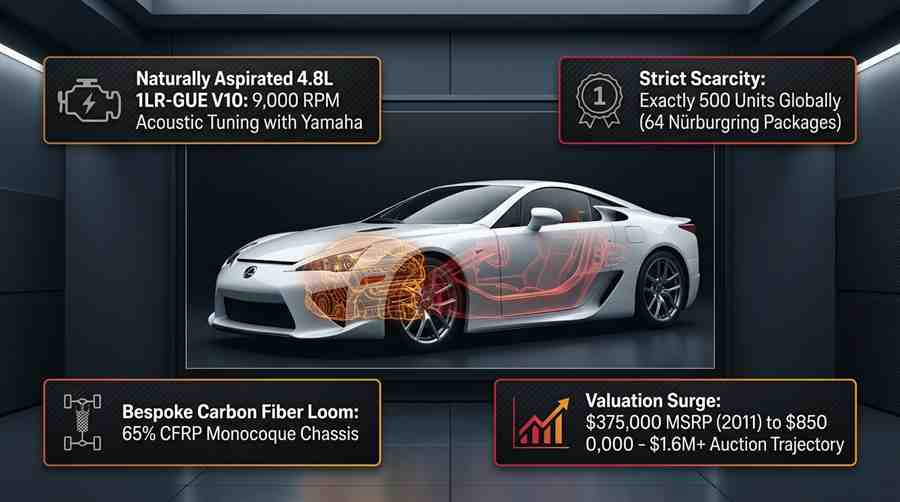
Key Metrics: How the Lexus LFA Compares to Modern Supercars
Evaluating the LFA purely on raw horsepower or 0–60 mph sprint times fails to capture the bespoke materials science that commands seven-figure collector auctions. Here is how the mechanical architecture benchmarks against contemporary hypercars:
| Engineering Parameter | Lexus LFA (Standard) | LFA Nürburgring Package | Valuation & Collector Impact |
|---|---|---|---|
| Global Production Volume | 436 Units | 64 Units | Strict artificial scarcity guarantees auction liquidity |
| Engine Architecture | 4.8L Even-Firing 72° V10 (1LR-GUE) | 4.8L Tuned V10 (563 HP) | Co-developed with Yamaha Musical Instruments |
| Redline & Rev Speed | 9,000 RPM (Idle to redline in 0.6s) | 9,000 RPM (Faster gear shifts) | Required first all-digital TFT cluster in a production car |
| Chassis Construction | 65% Carbon Fiber / 35% Aluminum | Carbon Monocoque + Fixed Carbon Wing | Woven on a proprietary 3D laser-guided carbon loom |
| Current Secondary Market Value | \$800,000 – \$950,000 | \$1,400,000 – \$1,800,000+ | Appreciated over 300% to 450% above original MSRP |
1. The 1LR-GUE V10: Formula 1 Engineering for the Street
The heart of the LFA’s legendary status is its bespoke 4.8-liter V10 engine, which revs from idle to its 9,000 RPM redline in an astounding 0.6 seconds. Analog needle tachometers could not keep pace with the crankshaft’s velocity, forcing Toyota to invent the modern digital Thin-Film Transistor (TFT) gauge cluster specifically for this vehicle.
Weighing less than Toyota’s standard 3.5L V6 while generating smaller dimensions than an ordinary V8, the 1LR-GUE utilized titanium connecting rods, forged aluminum pistons, and dry-sump lubrication. To perfect the engine’s acoustic footprint, Toyota partnered with Yamaha’s Musical Instrument Division, routing surgically tuned surge tanks and composite sound channels directly into the cabin to reproduce the harmonic signature of a late-1990s Formula 1 racecar.
2. Scrapping Aluminum for a Bespoke Carbon Fiber Loom
Five years into development, chief engineer Haruhiko Tanahashi scrapped the completed all-aluminum chassis because it was deemed too heavy to achieve target dynamic balance. Rather than outsourcing carbon production to European specialists, Toyota leveraged its historical industrial heritage in automated textiles to invent an automated circular 3D carbon fiber loom.
This proprietary manufacturing technique allowed engineers to weave continuous carbon fibers seamlessly into high-stress chassis sections, cutting 220 pounds (100 kg) from the frame while achieving unprecedented torsional rigidity. The financial toll was astronomical: re-engineering the entire vehicle in carbon fiber delayed delivery by four years and ensured Toyota would incur massive net losses on the project.
Operating costs on limited-production supercars are equally driven by powertrain complexity and scheduled dealership servicing. If you are examining high-end exotic operating budgets, review our empirical analysis of the cheapest Lamborghini models to maintain per year.
3. Extreme Scarcity and the Nürburgring Package Premium
Toyota capped production strictly at 500 hand-assembled vehicles between December 2010 and December 2012, building only 20 cars per month at the Motomachi plant. Each vehicle was handcrafted by a dedicated team of 170 master craftsmen (Takumi), who hand-signed each engine block with an individual serialized plaque.
Within this limited run, Toyota built only 64 Nürburgring Package editions designed for track dominance, featuring a fixed carbon rear wing, front aero canards, recalibrated 6-speed Automated Sequential Gearbox (ASG) shifts shortened to 0.15 seconds, and 10 additional horsepower. When chassis #003 of the Nürburgring edition crossed the block at RM Sotheby’s, it commanded a record-breaking \$1.6 million, cementing the LFA as a blue-chip alternative asset class.
4. The Last Pure Mechanical Supercar Era
Unlike modern hypercars equipped with regenerative braking, forced induction, and hybrid battery packs, the LFA provides unadulterated mechanical feedback through hydraulic steering. As global emissions regulations permanently eliminate high-revving naturally aspirated multi-cylinder powerplants, collectors view the LFA as an irreplicable milestone in automotive history.
Vehicle provenance, maintenance records, and low mileage hold enormous leverage in maintaining secondary values. Clean, accident-free examples with documentation verified through certified inspection registries consistently outperform general auction indices.
Frequently Asked Questions
-
What was the original MSRP of the Lexus LFA when new?
The Lexus LFA had an original manufacturer’s suggested retail price (MSRP) of \$375,000 in the United States, while the Nürburgring Package carried a sticker price of \$445,000. To deter immediate speculator flipping, Lexus initially leased vehicles to vetted customers for the first two years before transferring official ownership titles.
-
Did Toyota make a profit selling the Lexus LFA?
No, Toyota lost money on every single Lexus LFA manufactured across its entire production run. The company invested hundreds of millions of dollars over a 10-year development period, developing proprietary carbon looms and bespoke F1-grade V10 tooling that could never be amortized across just 500 production cars.
-
How many Lexus LFAs were built with the Nürburgring Package?
Toyota produced exactly 64 units of the Lexus LFA Nürburgring Package out of the total 500-car production run. In 2011, this competition-tuned variant completed a lap of the famed Nürburgring Nordschleife circuit in 7 minutes and 14.64 seconds, setting a production car record on standard street tires.
-
Why did the Lexus LFA require a digital tachometer?
The LFA’s 4.8-liter V10 revved from idle to 9,000 RPM in just 0.6 seconds, which was faster than a physical analog needle could track with mechanical precision. Lexus engineers were forced to build a custom high-resolution digital TFT LCD screen to accurately display engine speed in real time.
