
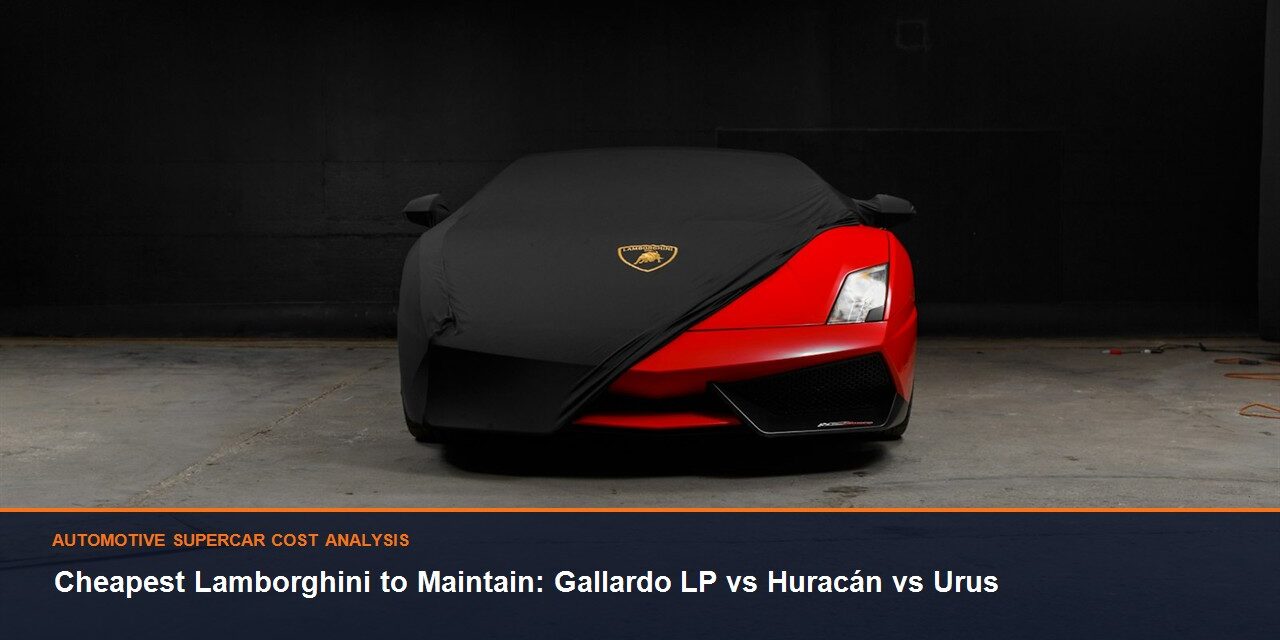
The cheapest Lamborghini to maintain per year is the late-generation Lamborghini Gallardo (LP-series, 2009–2014) in the supercar category, and the Lamborghini Urus in the daily driver category. A well-sorted Gallardo LP560-4 costs between $1,500 and $2,500 annually for routine fluid, filter, and sensor maintenance when serviced through independent exotic specialists. In the SUV segment, the Lamborghini Urus averages $2,000 to $3,500 per year for standard scheduled servicing due to extensive mechanical component sharing across the Volkswagen Audi Group (VAG) platform.
However, total cost of ownership differs significantly between scheduled maintenance and catastrophic component replacement. Early Gallardos (2004–2008) feature fragile E-Gear single-clutch systems requiring $8,000 to $12,000 replacements every 15,000 miles, while the modern Lamborghini Huracán features a bulletproof 7-speed dual-clutch transmission that practically eliminates transmission wear costs despite carrying slightly higher annual dealer service fees ($2,500 to $4,000). Below is the comprehensive, data-backed maintenance cost breakdown across every mainstream modern Lamborghini model.
Annual Maintenance Leaderboard at a Glance
- Cheapest V10 Supercar to Maintain: Gallardo LP-Series (2009–2014) — $1,500 – $2,500 / year (Audi R8 parts sharing).
- Most Mechanically Reliable: Huracán LP610-4 / Evo — $2,500 – $4,000 / year (Bulletproof dual-clutch; zero E-gear wear).
- Cheapest Routine Utility: Lamborghini Urus — $2,000 – $3,500 / year (Audi RS Q8 / Porsche Cayenne platform).
- Most Expensive (Avoid for Budget): Murciélago / Aventador V12 — $6,000 – $15,000+ / year (Inboard suspension & engine-out repairs).
The Audi Connection: Why the Gallardo LP and Huracán Are Maintainable
Before Audi acquired Automobili Lamborghini in 1998, maintaining a vintage Countach or Diablo required bespoke Italian fabrication and frequent engine-out services. The introduction of the Gallardo in 2004 completely transformed Lamborghini reliability by integrating German manufacturing tolerances, Bosch engine management electronics, and Audi assembly protocols.
The 5.2-liter naturally aspirated V10 found in the second-generation Gallardo (LP560-4, LP550-2, LP570-4) and the Huracán is mechanically identical to the powerplant in the first-generation Audi R8 V10. Because thousands of these engines were produced globally, replacement spark plugs, ignition coils, oil filters, oxygen sensors, and alternator pulleys carry standard Audi part numbers that cost 60% to 80% less than the exact same part in a Lamborghini-branded box.

Figure 1: Comprehensive annual maintenance, clutch durability, and consumable wear comparison across modern Lamborghinis.
Model-by-Model Annual Maintenance Breakdown
Evaluating ownership costs requires analyzing routine annual inspections, major multi-year services, and predictable consumable wear items:
| Model & Generation | Routine Annual Service | Major Service (Every 2–3 Years) | Transmission / Clutch Upkeep |
|---|---|---|---|
| Gallardo Early Gen (2004–2008) | $1,800 – $3,000 | $4,000 – $6,500 | E-Gear Clutch: $8,000–$12,000 every 15k mi |
| Gallardo LP-Series (2009–2014) | $1,500 – $2,500 | $3,500 – $5,000 | Improved E-Gear / Manual: 30k–45k mi life |
| Huracán (2015–2024) | $2,500 – $4,000 | $4,500 – $7,000 | 7-Speed LDF Dual-Clutch (60k+ mi life) |
| Urus Super SUV (2018+) | $2,000 – $3,500 | $3,500 – $5,500 | ZF 8-Speed Torque Converter (Near-zero wear) |
| Aventador V12 (2012–2022) | $5,000 – $8,000 | $10,000 – $18,000+ | Single-Clutch ISR ($12,000–$16,000) |
1. The Budget King: Gallardo LP-Series (2009–2014)
If your objective is to own a mid-engine, scissor-free Italian exotic without experiencing financial ruin, the second-generation Gallardo (LP) is the definitive choice.
Introduced for the 2009 model year, the LP560-4 corrected virtually all chronic issues from the original 2004–2008 cars. The finicky 5.0L dry-sump engine was replaced by the robust 5.2L direct-injected unit featuring timing chains rather than belts, eliminating catastrophic timing belt failures. Furthermore, the E-Gear hydraulic pump and clutch actuation software were recalibrated, extending clutch life from an abysmal 15,000 miles to over 35,000 miles under prudent driving conditions.
2. The Reliability Winner: Lamborghini Huracán
While the Huracán demands slightly higher routine annual dealer fees, it is by far the most dependable supercar Lamborghini has ever engineered.
The standout mechanical advancement is the 7-speed Lamborghini Doppia Frizione (LDF) dual-clutch transmission. Gone are the days of monitoring clutch snap readings at every service interval; the LDF functions with the smooth predictability of an Audi S-Tronic or Porsche PDK, regularly surpassing 60,000 miles without clutch wear degradation. If you drive 5,000+ miles per year, the Huracán’s lower failure frequency makes it cheaper to live with than an aging first-generation Gallardo.
3. The Practical Fleet Winner: Lamborghini Urus
Built on the Volkswagen MLB Evo platform, the Urus is mechanically closer to an Audi RS Q8 or Porsche Cayenne Turbo than an Italian track weapon.
Its twin-turbocharged 4.0L V8 and ZF 8-speed torque converter transmission are exceptionally reliable, meaning any competent European specialty shop can perform oil changes, cabin air filter replacements, and spark plug services for under $2,000 per year. However, owners must budget for heavy consumable wear: its massive 22- or 23-inch Pirelli P Zero tires cost $2,200 to $3,200 per set and last only 12,000 to 18,000 miles, while carbon-ceramic brake rotor replacements can exceed $15,000 if neglected.
3 Insider Strategies to Cut Lamborghini Maintenance by 50%
Experienced supercar owners preserve thousands of dollars annually by executing three operational strategies:
- Ditch the Official Dealership for Specialized Independents: Authorized Lamborghini dealerships charge $280 to $380+ per hour in diagnostic labor. Certified independent exotic mechanics (often former factory-trained technicians) offer identical factory diagnostic software at $160 to $220 per hour.
- Cross-Reference Audi Part Numbers: Before purchasing a $450 Lamborghini-branded oil filter or $300 throttle sensor, cross-reference the VAG part stamped on the component. In over 60% of cases on Gallardos and Huracáns, the identical OEM Audi R8 part is available from dealership parts counters for a fraction of the price.
- Avoid Aggressive Reverse Maneuvers on E-Gear Cars: On Gallardo E-Gear models, reversing up steep inclines causes continuous clutch slip, burning through thousands of dollars of friction material in seconds. Always park nose-in or select reverse on flat ground.
For exotic automotive enthusiasts examining vehicle styling and protective finishes, exploring our technical guide on vinyl vehicle wraps and paint protection film engineering and our analysis on performance tire compound safety provides essential mechanical depth.
Frequently Asked Questions (FAQ)
-
What is the absolute cheapest Lamborghini to maintain?
The second-generation Lamborghini Gallardo LP (2009–2014) is the cheapest mid-engine supercar to maintain, averaging $1,500 to $2,500 per year. For everyday utility, the Lamborghini Urus offers the lowest routine servicing costs ($2,000 to $3,500/year) due to shared Audi/Porsche mechanical parts.
-
Is a Lamborghini Huracán more reliable than a Gallardo?
Yes, the Lamborghini Huracán is significantly more reliable than an early Gallardo. The Huracán’s 7-speed LDF dual-clutch transmission completely eliminates the expensive clutch burn-outs ($8,000–$12,000) that plagued early single-clutch E-Gear Gallardos.
-
Can regular Audi dealerships service a Lamborghini Gallardo or Huracán?
Many Audi dealerships certified to work on the Audi R8 V10 can service Gallardos and Huracáns for basic mechanical items. However, specialized independent exotic automotive repair shops are generally preferred for full computer diagnostics, suspension calibrations, and clutch telemetry reads.
-
Why is the Lamborghini Aventador so much more expensive to maintain?
The Aventador features a bespoke 6.5L V12 engine and single-clutch ISR transmission that does not share mass-production parts with Audi. Routine major services average $5,000 to $10,000+, and complex repairs often require disassembling the pushrod suspension or removing the entire drivetrain.
