

Managing irregular business income requires decoupling your monthly operating expenditure from your fluctuating cash receipts through a structured buffer reserve system. Freelancers, project-based agencies, seasonal businesses, and commission-based consultants cannot operate on static personal spending habits. When revenue swings between lean valleys and peak surplus months, treating variable top-line inflows as immediately spendable cash guarantees liquidity crises.
Stabilizing irregular income transforms volatile earnings into predictable operational distributions. Instead of enduring feast-or-famine cycles, disciplined operators implement an intermediary holding account that acts as a financial shock absorber. This governance structure ensures payroll, vendor payables, and personal salaries clear seamlessly every single month.
The Irregular Income Equilibrium Formula
Baseline Monthly Draw = (Lowest Historical Monthly Revenue × 80%) OR Verified Baseline Overhead
Where revenue exceeding this baseline routes directly into a segregated buffer account rather than operational or personal withdrawal accounts.
The 5-Stage Framework to Master Irregular Business Income
A volatile top line does not necessitate volatile personal compensation or inconsistent vendor payments. Implement this battle-tested 5-stage framework to engineer artificial predictability across unpredictable revenue environments:
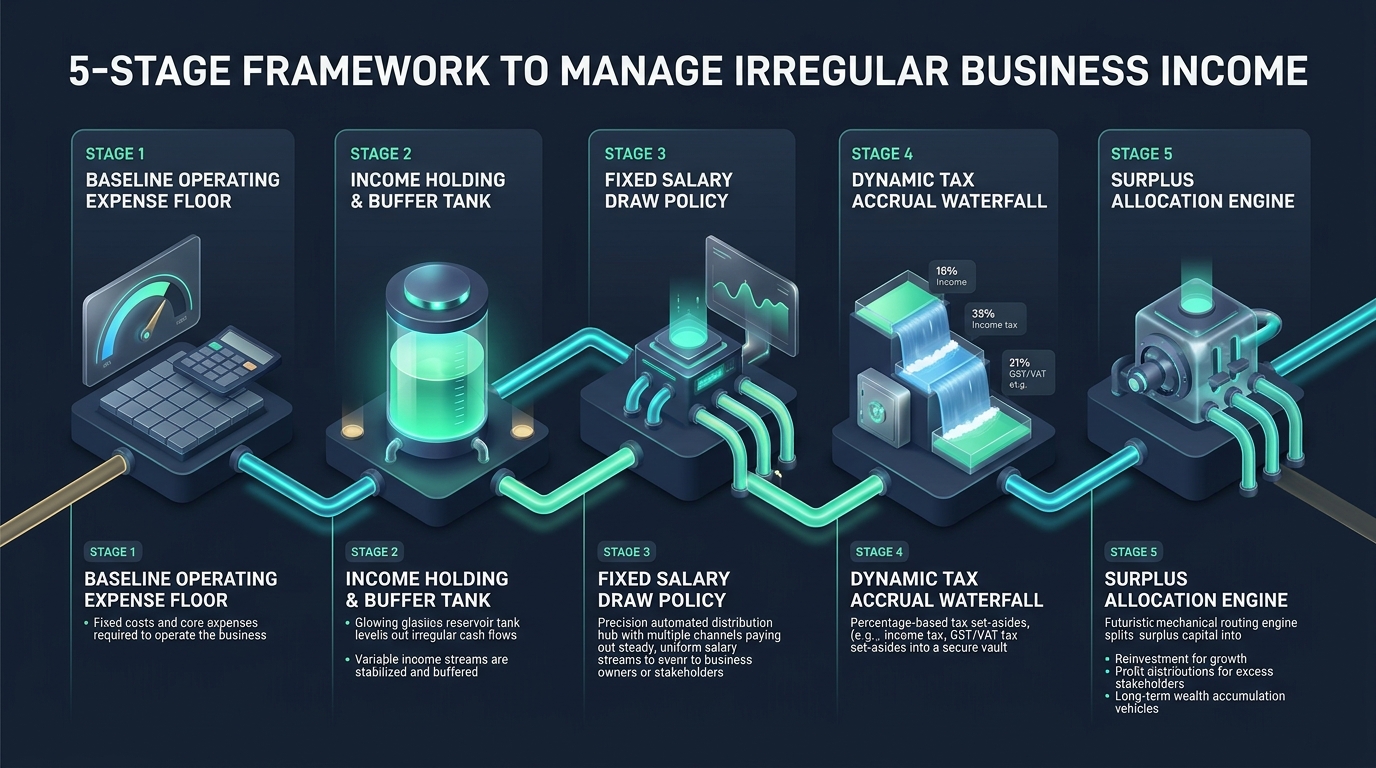
1. Determine Your Absolute Baseline Expense Floor
Calculate the non-negotiable monthly capital required to keep your business alive during zero-revenue periods. Sum fixed operating expenses—including essential software subscriptions, office space, base payroll, legal overhead, and baseline debt service. Pair this with your non-negotiable personal survival budget. This composite number forms your monthly break-even threshold.
2. Establish an Intermediary Revenue Holding Account
Route 100% of incoming client payments into a dedicated income clearing account rather than your operational checking account. Treat this holding account as an unallocated reservoir. Funds do not disperse instantly upon arrival. Instead, transfer a single predetermined lump sum from this holding tank into operating checking on the first business day of each month.
3. Enforce a Fixed Salary Draw Policy
Pay yourself a fixed, consistent salary twice per month regardless of monthly revenue totals. In a \$25,000 month, take the identical draw as in an \$8,000 month. Surplus capital generated during peak billing cycles remains sequestered within your buffer account to fund shortfalls during seasonal dips. Managing disciplined baseline costs goes hand-in-hand with standard overhead tracking, which we detail in our guide on how to manage business expenses monthly.
4. Automate the Percentage-Based Tax Waterfall
Deduct tax liabilities the instant money hits your holding account before touching operational capital. Allocate 25% to 35% of every cleared customer deposit directly into a segregated tax savings account. When quarterly estimated taxes come due (such as IRS Form 1040-ES or state tax payments), the required cash sits fully funded and untouched by operating pressures.
5. Deploy a Structured Surplus Allocation Engine
Establish formal financial rules for deploying capital once your buffer reaches maximum target depth. Once your holding buffer holds 6 months of fixed expenses, divide excess monthly cash into three distinct buckets: 50% retained earnings for strategic growth, 30% owner profit dividend, and 20% debt paydown or asset expansion.
Buffer Account Architecture: Feast vs. Famine Capital Flow
| Operational Dimension | Feast Months (High Revenue) | Famine Months (Low Revenue) |
|---|---|---|
| Customer Cash Inflows | 150% to 250% of monthly average | 30% to 60% of monthly average |
| Owner Draw / Salary | Fixed baseline amount (e.g., \$7,000) | Identical fixed baseline amount (\$7,000) |
| Buffer Reservoir Action | Net cash deposits fill buffer to 6-month cap | Controlled withdrawal fills the operating deficit |
| Tax Allocation Cadence | Immediate 30% transfer to segregated tax account | Proportional 30% transfer on realized deposits |
| Discretionary Capex | Restricted until 6-month buffer fully funded | Completely frozen; non-essential subscriptions paused |
Strategic Techniques to Smooth Uneven Revenue Streams
Transitioning project-based clients into recurring retainers offers the fastest structural remedy for irregular income. Convert one-off deliverables into ongoing maintenance, advisory, or performance retainers. Even converting 30% of your total client roster into predictable monthly recurring revenue (MRR) creates a sturdy floor that covers your core fixed overhead.
Enforce strict milestone billing and upfront mobilization deposits on major contracts. Never finance client deliverables out of your own cash flow. Structure contracts with a 40% upfront deposit upon contract signing, 30% at the midpoint milestone, and 30% upon final acceptance.
Incentivize annual prepayments by offering modest rate discounts. Providing a 10% to 15% discount for full annual upfront payments immediately injects non-dilutive liquidity into your holding account. This upfront capital deepens your reserve buffer without taking on bank debt or costly credit lines.
Tax and Regulatory Compliance for Volatile Income Businesses
The Internal Revenue Service (IRS) penalizes businesses that fail to remit sufficient quarterly estimated taxes under Section 6654. If your income concentrates heavily in Q3 and Q4, utilizing the Annualized Income Installment Method (Form 2210, Schedule AI) protects you from underpayment penalties by matching tax liability directly to the timing of your income.
Operating as an S-Corporation requires extra diligence with reasonable compensation requirements. The IRS mandates that shareholder-employees receive reasonable W-2 wages before distributing profit dividends. Maintaining a steady W-2 salary funded through your holding buffer ensures regulatory compliance while shielding the remainder of variable profits from self-employment taxes.
Monthly Governance Checklist for Irregular Income
Piyush Dwivedi’s Monthly Irregular Income Protocol
- 1st of the Month Transfer: Move fixed operational overhead and fixed salary from the Income Holding Account to Operational Checking.
- Tax Segregation Audit: Verify that 25% to 30% of all gross receipts from the prior month reside in the dedicated Tax Reserve.
- Buffer Runway Calculation: Divide total liquid holding balance by monthly baseline burn to confirm total months of runway.
- Accounts Receivable Follow-Up: Issue automated payment reminders for any client invoices approaching 15 days outstanding.
- Profit Distribution Review: Release discretionary profit dividends only when total reserves exceed the 6-month threshold.
How much should a small business keep in a buffer reserve?
A small business with irregular income should maintain a cash buffer equal to 3 to 6 months of fixed baseline operating expenses. This reserve absorbs invoice collection delays and seasonal revenue dips without compromising payroll.
How do I calculate my personal salary when business income fluctuates?
Calculate your baseline salary by taking 80% of your average lowest-earning month over the past 12 to 24 months. Pay yourself this exact figure consistently, leaving surplus revenue in your holding account to support lean periods.
What bank account structure works best for managing irregular income?
The most effective structure uses four separate accounts: an Income Holding Account (where all revenue lands), an Operational Checking Account (monthly overhead), a Tax Savings Account (25-30% automatic tax withholdings), and a Capital Reserve Account (growth & buffer).
How can I prevent IRS underpayment penalties with fluctuating income?
Use IRS Form 2210 (Annualized Income Installment Method) to calculate estimated taxes based on actual quarterly earnings rather than equal quarterly installments. Alternatively, utilize the safe harbor rule by paying 100% (or 110% for high earners) of the prior year’s total tax liability.
What should I do during a prolonged revenue drought?
Immediately pause all discretionary subscriptions and non-essential expenses, activate payment reminders for outstanding accounts receivable, draw strictly the bare-minimum survival salary from your buffer, and package short-term discounted service offerings for existing clients.
-
How much should a small business keep in a buffer reserve?
A small business with irregular income should maintain a cash buffer equal to 3 to 6 months of fixed baseline expenses. This reserve absorbs invoice collection delays and seasonal revenue contractions without compromising payroll or vendor trust.
-
How do I calculate my personal salary when business income fluctuates?
Calculate your baseline salary based on 80% of your average lowest-earning month over the prior 12 to 24 months. Pay yourself this exact figure consistently, leaving surplus revenue in your holding account to fund leaner operational periods.
-
What bank account structure works best for managing irregular income?
Deploy four distinct accounts: Income Holding, Operational Checking, Tax Savings, and Capital Reserve. Clearing all customer receipts into an isolated holding tank prevents impulsive overspending during peak revenue months.
-
How can I prevent IRS underpayment penalties with fluctuating income?
File IRS Form 2210 using the Annualized Income Installment Method to match payments with actual quarterly revenue timing. Alternatively, satisfy the safe harbor rule by paying 100% (or 110% for high earners) of your prior year’s tax liability.
-
What should I do during a prolonged revenue drought?
Immediately freeze discretionary overhead, draw strictly survival pay from your buffer, and launch short-term service promotions to active clients. Aggressively collecting outstanding accounts receivable restores liquidity before reserves deplete.
