

To completely eliminate wire transfer fees on international incoming payments, you must bypass the traditional SWIFT correspondent banking network by adopting local multi-currency collection accounts or enforcing strict “OUR” charge instructions on commercial invoices. Standard international wire transfers pass through one to three correspondent intermediary banks, each deducting between $15 and $50 in unregulated handling charges. In addition, traditional recipient banks levy incoming wire fees of $15 to $35 alongside hidden 2% to 5% foreign exchange (FX) retail markup spreads, frequently eroding $65 to over $150 per client invoice.
By providing overseas clients with native domestic banking credentials (such as US Routing/Account numbers via ACH, Eurozone IBANs via SEPA, or UK Sort Codes via Faster Payments), payments clear as zero-fee domestic transfers. When SWIFT routing is mandatory, contractually mandating Field 71A “OUR” codes shifts 100% of transaction fees onto the sender. Below is the operational treasury blueprint to protect your international receivables from correspondent banking leakage.
Core Executive Takeaway: The 3-Pillar Fee Defense
- Pillar 1 (The Local Rail Strategy): Collect via virtual multi-currency accounts (Wise Business, Airwallex, Revolut) to receive local ACH/SEPA payments with $0 incoming fees.
- Pillar 2 (The SWIFT Protocol Fix): Specify SWIFT Charge Code “OUR” on invoices, preventing intermediaries from deducting fees from your principal payout.
- Pillar 3 (FX Margin Shield): Always invoice and settle in the client’s home currency to prevent predatory 3%–5% correspondent bank conversion markups.
The Anatomy of SWIFT Intermediary Wire Deductions
International wire transfers rarely travel directly between two commercial banks. Because your local bank likely lacks a direct balance relationship (nostro/vostro account) with your client’s overseas financial institution, transactions route through the Society for Worldwide Interbank Financial Telecommunication (SWIFT) correspondent network.
Every correspondent intermediary institution handling the payment message extracts a “lifting” or routing fee directly from the transiting balance. If your payment hops across two intermediary banks before landing in your domestic account, both institutions silently deduct $20 to $40 without itemized notification. Finally, your own bank charges an incoming international wire processing fee ($15 to $30), leaving a significant discrepancy between your gross invoice total and actual cash received.
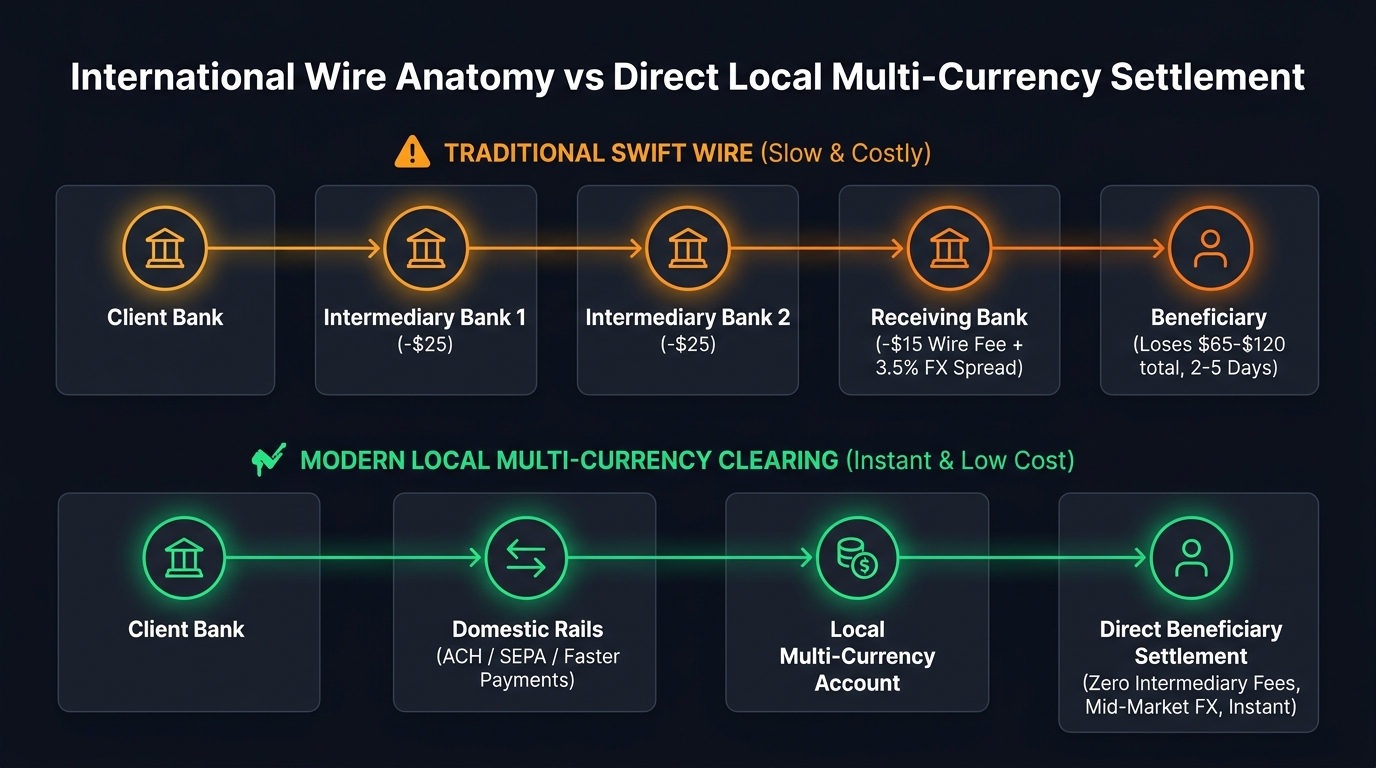
Figure 1: Traditional SWIFT intermediary fee erosion vs. direct local multi-currency settlement.
SWIFT Charge Codes: Demystifying Field 71A (OUR vs. SHA vs. BEN)
When an overseas client initiates an international wire, their banking interface requires them to select a charge instruction under SWIFT Field 71A. Understanding these three designations determines who pays the processing costs.
| SWIFT Code (Field 71A) | Who Pays Intermediary Charges? | Impact on Your Incoming Payment |
|---|---|---|
| BEN (Beneficiary Pays) | Receiver pays 100% of all network fees | Worst option: Senders bank, intermediaries, and recipient bank all slice fees from your principal. |
| SHA (Shared Charges) | Sender pays sending bank; receiver pays intermediaries | Default trap: Intermediary cuts ($25–$60) and incoming wire fees still deduct from your transfer. |
| OUR (Sender Pays All) | Sender pays sending, correspondent, and handling fees | Recommended for SWIFT: You receive 100% of the invoice gross amount without network slicing. |
To implement this defense, incorporate a mandatory clause on all international commercial agreements and billing schedules:
Payment Terms: All international SWIFT wire transfers must be transmitted under Charge Code "OUR" (Field 71A). Any intermediary handling deductions or short-payments remain the legal liability of the payer and will be rebilled on subsequent statements.
Method 1: Local Multi-Currency Collection Accounts (The Complete Zero-Fee Fix)
The most comprehensive method to eliminate incoming wire fees is to stop receiving SWIFT transfers altogether. Modern enterprise fintech platforms provide business owners with local receiving accounts across tier-1 global jurisdictions.
When billing a client in the United States, provide them with an American ACH routing and account number. When billing in Germany or France, issue an EU SEPA IBAN. To your client’s accounts payable department, the transaction is an ordinary domestic transfer requiring zero cross-border wiring fees:
- United States: Receive via ACH Direct Deposit or domestic Fedwire (Zero intermediary fees, zero sender pushback).
- Eurozone: Receive via SEPA (Single Euro Payments Area) or SEPA Instant (Free or sub-€1 standard domestic processing).
- United Kingdom: Receive via Faster Payments or BACS (Zero incoming network charges).
- Canada & Australia: Receive via EFT / Interac or BECS / PayID.
Platforms like Wise Business, Airwallex, and Revolut Business credit incoming domestic payments at zero cost. Once funds land in your digital treasury balance, you can hold them in their native currency to pay overseas contractors, or convert them to your home currency at the true mid-market exchange rate for a minimal transparent fee of 0.3% to 0.5%.
Method 2: Optimize Legacy Bank Correspondent Routing Instructions
If you must utilize a traditional brick-and-mortar commercial bank, do not rely on standard automated routing. Request a formal “Correspondent Bank Routing Sheet” directly from your financial institution’s international treasury desk.
Many secondary regional banks do not manage direct currency clearing houses. If an Australian client wires USD to a regional credit union, the funds may bounce through three separate correspondent institutions. Supplying your client with the specific primary correspondent institution preferred by your bank (e.g., JPMorgan Chase, Citibank, or Deutsche Bank AG) eliminates unnecessary intermediary routing hops, minimizing unexpected fees.
Eliminating Hidden Foreign Exchange (FX) Spread Markups
Even when wire fees appear low on paper, traditional banks routinely extract 2% to 5% of your incoming revenue through predatory currency spreads. If an overseas client sends an invoice denominated in their currency into a local currency account, your receiving bank applies an arbitrary “retail exchange rate” rather than the interbank rate.
On a $50,000 commercial payment, a 3.5% retail spread extracts $1,750 in invisible fees. To completely neutralize FX extraction:
- Open Native Multi-Currency Wallets: Maintain separate digital accounts for USD, EUR, GBP, and CAD so funds land uncoverted.
- Contractual Currency Alignment: State clearly that invoices must be settled in the exact denomination indicated, barring the sender’s bank from executing automated cross-currency conversion.
- Strategic Treasury Conversion: Batch convert foreign holdings only when favorable spot market conditions emerge, using wholesale institutional FX brokers.
For organizations engineering cash flow resilience, reviewing our guide on cash vs accrual accounting frameworks and our operational strategy on managing irregular enterprise income streams provides vital liquidity management depth.
Frequently Asked Questions (FAQ)
-
Can a recipient completely avoid international incoming wire fees?
Yes, recipients can avoid incoming wire fees by using multi-currency accounts that provide local domestic bank details. Providing clients with local ACH, SEPA, or Faster Payments account numbers routes payments over domestic clearing systems, bypassing the SWIFT network and all intermediary fees.
-
What happens if a client sends a wire with the SHA instruction?
Under the SHA (Shared) instruction, you pay all intermediary bank fees and your receiving bank’s incoming wire fee. These intermediary handling costs ($20 to $50) are deducted directly from the incoming principal amount before the money is credited to your bank account.
-
Why did I receive less money than what was invoiced on a wire transfer?
You received less money because intermediary correspondent banks deducted routing fees during transit. When wires travel across multiple correspondent financial institutions under SHA or BEN instructions, each institution automatically takes a cut from the principal balance.
-
Does the SWIFT “OUR” code guarantee 100% of the funds will arrive?
The “OUR” code mandates the sender pay all processing charges, ensuring full payout in 95%+ of cases. In rare scenarios involving exotic currencies or multiple non-standard correspondent institutions, minor secondary clearing cuts can occur, making local multi-currency rails the only 100% guaranteed zero-deduction solution.
