

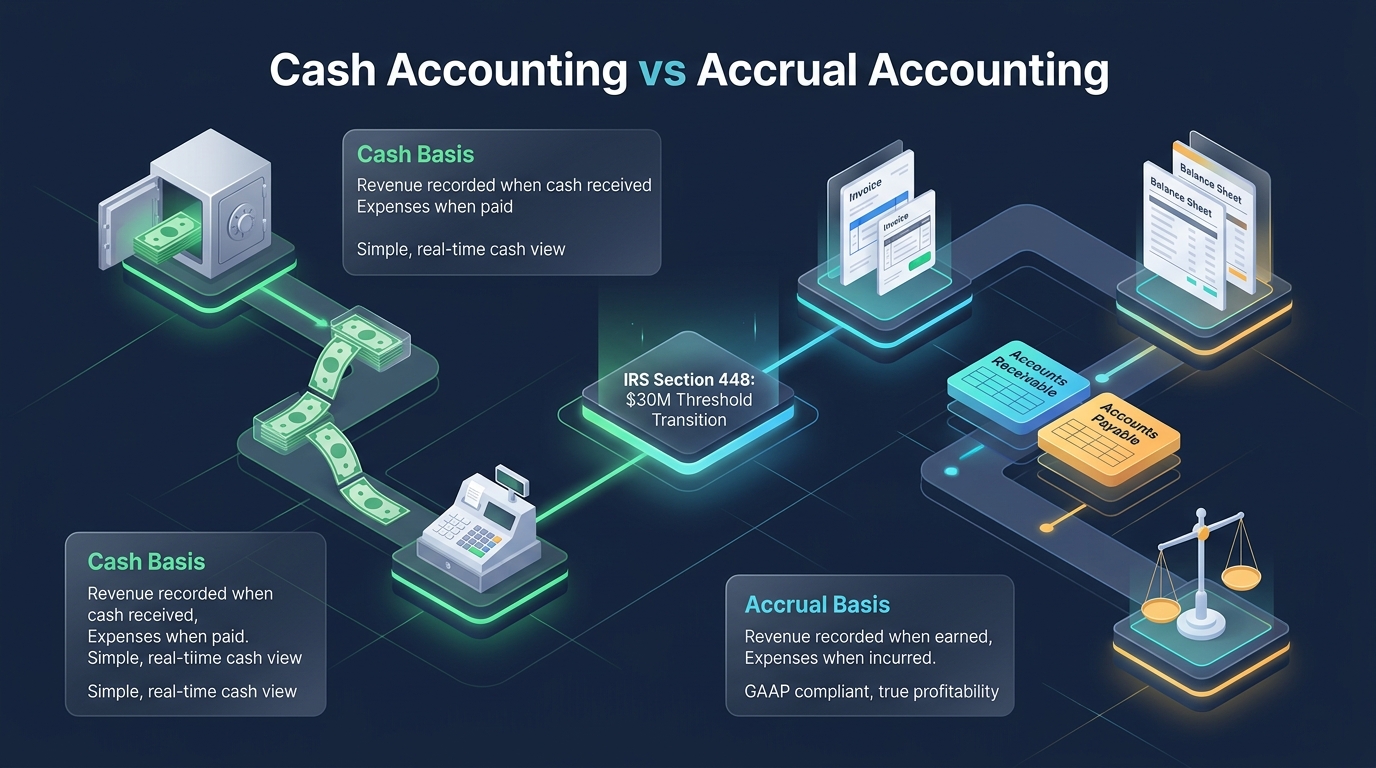
The primary difference between cash accounting and accrual accounting lies in the exact timing of when revenue and expenses are officially recognized in your financial books. Cash accounting records income only when cash clears into your bank account and deducts expenses only when money exits. In contrast, accrual accounting recognizes revenue the moment it is earned upon invoicing and matches expenses when they are incurred, regardless of when physical cash changes hands.
Selecting the wrong accounting method distorts your true profitability and exposes growing small businesses to painful tax compliance pitfalls. Companies experiencing uneven revenue distributions must maintain airtight financial buffers, as outlined in our blueprint on how to manage irregular business income. Furthermore, mastering expense categorization across both methods directly enhances bottom-line cash controls, detailed in our strategic guide on how to manage business expenses monthly.
The Fundamental Recognition Rule
Cash Basis: Transaction Date = Cleared Bank Settlement Date
Accrual Basis: Transaction Date = Invoicing / Obligation Incurred Date (GAAP Matching Principle)
Accrual accounting reflects economic reality; cash accounting reflects immediate liquid purchasing power.
Cash Accounting vs. Accrual Accounting: Direct Comparison
Evaluating which bookkeeping system aligns with your business model requires examining how each treats assets, liabilities, and statutory tax obligations. The matrix below compares the foundational dimensions of both systems:
| Operational Metric | Cash Basis Accounting | Accrual Basis Accounting |
|---|---|---|
| Revenue Recognition | When customer cash deposits clear bank | When goods/services are delivered & invoiced |
| Expense Recognition | When payments leave your bank account | When bills/expenses are incurred (Matching Principle) |
| A/R and A/P Tracking | Not tracked on formal balance sheet | Tracked continuously on balance sheet |
| Tax Liability Impact | Pay taxes strictly on cash collected | Pay taxes on invoiced sales, even if unpaid |
| Complexity & Bookkeeping Cost | Low complexity; minimal CPA maintenance | Moderate to high; requires double-entry rigor |
| GAAP Compliance | Non-compliant with US GAAP standards | 100% compliant with US GAAP & IFRS |
| Investor & Bank Suitability | Rarely accepted for major bank loans or VC | Mandatory for institutional debt, equity, or audits |
Cash Basis Accounting: Mechanics, Advantages, and Blind Spots
Cash basis accounting functions like an expanded corporate checkbook ledger. Solopreneurs, service freelancers, and small consultancies favor this approach because it requires zero knowledge of complex accounting entries like unearned deferred revenue or accrued liabilities.
Core Advantages
- Single-Glance Liquidity Visibility: Your financial statements reflect the exact spendable cash residing in your operational accounts today.
- Tax Timing Flexibility: Business owners can legally defer taxable net income into the following fiscal year by delaying December customer billings or accelerating deductible vendor expense payments before year-end.
- Minimal Overhead Expense: Bookkeeping requires fewer accounting software subscriptions and less CPA preparation time.
Critical Vulnerabilities
Cash accounting creates a misleading illusion of corporate health. A business could show \$50,000 in cash profit during a month simply because several major clients paid historic bills simultaneously, while concealing \$80,000 in unpaid vendor bills due the following Monday. By ignoring accounts payable and receivable, cash accounting obscures long-term solvency.
Accrual Basis Accounting: Mechanics, Advantages, and Blind Spots
Accrual accounting operates under the GAAP Matching Principle, which dictates that revenues and their associated production expenses must be reported in the exact same reporting period. If you incur \$10,000 in labor and raw materials to fulfill a contract in March, the corresponding \$18,000 revenue is booked in March upon invoicing—even if the client pays 60 days later in May.
Core Advantages
- True Economic Profitability: By matching costs directly to the revenue they generated, monthly financial statements accurately reveal true operating margins.
- Long-Term Strategic Planning: Lenders, private equity investors, and commercial banks require accrual accounting to evaluate your enterprise creditworthiness and operational efficiency.
- Advanced Accounts Receivable Auditing: Formal tracking of aging receivables prevents uncollectible claims and minimizes bad debt write-offs.
Critical Vulnerabilities
The primary danger of accrual accounting is paper profitability masking cash insolvency. A company can report \$250,000 in net accounting profit while sitting on an overdrawn bank balance if clients delay invoice remittances. Furthermore, businesses must remit federal income taxes on invoiced sales even if the customer has not yet sent payment.
Concrete Numerical Case Study: The \$60,000 Enterprise Project
To visualize how the two methods diverge in practice, consider an IT consulting firm delivering a \$60,000 software contract in November with \$35,000 in direct contractor expenses. The client contract features Net 60 payment terms, meaning payment arrives in January of the next calendar year.
| Reporting Metric | Cash Accounting (Year 1: Nov/Dec) | Accrual Accounting (Year 1: Nov/Dec) |
|---|---|---|
| Recognized Gross Revenue | \$0.00 (Cash not yet collected) | \$60,000.00 (Invoiced upon delivery) |
| Recognized Project Expenses | \$35,000.00 (Paid to contractors in Dec) | \$35,000.00 (Incurred in Nov/Dec) |
| Reported Net Profit / (Loss) | (\$35,000.00) Artificial Net Loss | +\$25,000.00 True Economic Profit |
| Tax Consequence for Year 1 | Tax deduction offsets other business profits | Income tax owed on \$25,000 profit before payment clears |
| Year 2 (January Outcome) | +\$60,000 profit recorded (lumpy tax hit) | \$0.00 profit impact (A/R converts to cash) |
IRS Regulatory Thresholds: When Accrual Accounting Becomes Mandatory
Under Internal Revenue Code (IRC) Section 448, small businesses with average annual gross receipts under \$30 million (indexed for inflation) are generally permitted to use the cash method of accounting for federal tax purposes. However, the IRS legally mandates the accrual accounting method under specific statutory conditions:
- The Gross Receipts Test: C-Corporations and partnerships with C-Corporation partners exceeding the 3-year average annual gross receipts cap (\$30 million threshold) must transition to accrual.
- Tax Shelters and Syndicates: Any enterprise classified as a tax shelter under Section 461(i) is strictly prohibited from utilizing the cash method.
- Inventory Accounting Requirements: While the Tax Cuts and Jobs Act (TCJA) exempted many small businesses from mandatory inventory accrual, businesses maintaining substantial physical merchandise must still account for inventory under methods that clearly reflect income.
The Hybrid Accounting Method: A Practical Compromise
Many growing mid-market enterprises adopt a hybrid accounting approach to capture the strategic benefits of both systems. Under a hybrid model, the business maintains internal management books on an accrual basis for weekly executive decision-making, while filing year-end corporate tax returns on a cash basis.
Modern cloud accounting platforms like QuickBooks Online and Xero allow users to toggle between Cash and Accrual reporting with a single click. This dual visibility enables operators to review true gross margin trends without forfeiting the cash-basis tax deferral advantages permitted by the IRS.
Decision Framework: Which Method Should Your Small Business Choose?
Piyush Dwivedi’s Method Selection Protocol
- Choose Cash Accounting If: You run a solo service business, collect payments immediately via point-of-sale credit card processing, carry zero physical inventory, and prioritize bookkeeping simplicity.
- Choose Accrual Accounting If: You extend 30-to-90-day credit terms to enterprise clients, manage physical warehouse inventory, carry significant contractor accounts payable, or plan to raise bank debt or venture capital within 18 months.
- Execute Method Changes Legally: If switching methods for federal tax purposes, file IRS Form 3115 (Application for Change in Accounting Method) in consultation with a licensed CPA.
Which is better for a small business: cash or accrual accounting?
Neither method is universally better; cash accounting is ideal for small service businesses seeking simplicity and cash visibility, while accrual accounting is superior for growing businesses extending trade credit terms or seeking commercial financing.
Can a small business switch from cash to accrual accounting?
Yes, a business can transition from cash to accrual accounting by filing IRS Form 3115 (Application for Change in Accounting Method) and making required Section 481(a) adjustments to prevent revenue from being duplicated or omitted.
Why do banks prefer accrual accounting?
Banks prefer accrual accounting because it follows GAAP standards, accurately reflects earned income and outstanding obligations, and provides an authentic measure of long-term operational profitability rather than temporary cash swings.
Do you have to pay taxes on unpaid invoices in accrual accounting?
Yes, under accrual accounting, invoiced sales are recognized as taxable revenue in the tax year they are billed, even if the customer has not yet remitted payment by December 31st.
What is the IRS income limit for cash basis accounting?
Under the Tax Cuts and Jobs Act, businesses with average annual gross receipts of $30 million or less over the prior three tax years can legally use the cash method of accounting for federal tax reporting.
-
Which is better for a small business: cash or accrual accounting?
Cash accounting is best for sole proprietors seeking simple cash tracking, while accrual is mandatory for growing firms with complex trade credit. Businesses extending Net 30 or Net 60 terms require accrual models to prevent severe financial blind spots.
-
Can a small business switch from cash to accrual accounting?
Yes, businesses can switch methods by submitting IRS Form 3115. Your CPA calculates Section 481(a) adjustments to ensure outstanding receivables and payables are neither duplicated nor omitted from taxable income.
-
Why do banks prefer accrual accounting?
Banks prefer accrual statements because they adhere to US GAAP principles and reveal true operating margins. Accrual matching links revenues directly to production expenses, eliminating erratic monthly cash spikes.
-
Do you have to pay taxes on unpaid invoices in accrual accounting?
Yes, accrual accounting recognizes billed revenue as taxable income upon invoicing. If an invoice is issued in late December, tax liability accrues immediately even if payment arrives in February.
-
What is the IRS income limit for cash basis accounting?
The IRS gross receipts threshold is \$30 million across the prior three tax years under IRC Section 448. Qualifying small businesses beneath this threshold maintain full legal discretion to utilize the cash method.
