
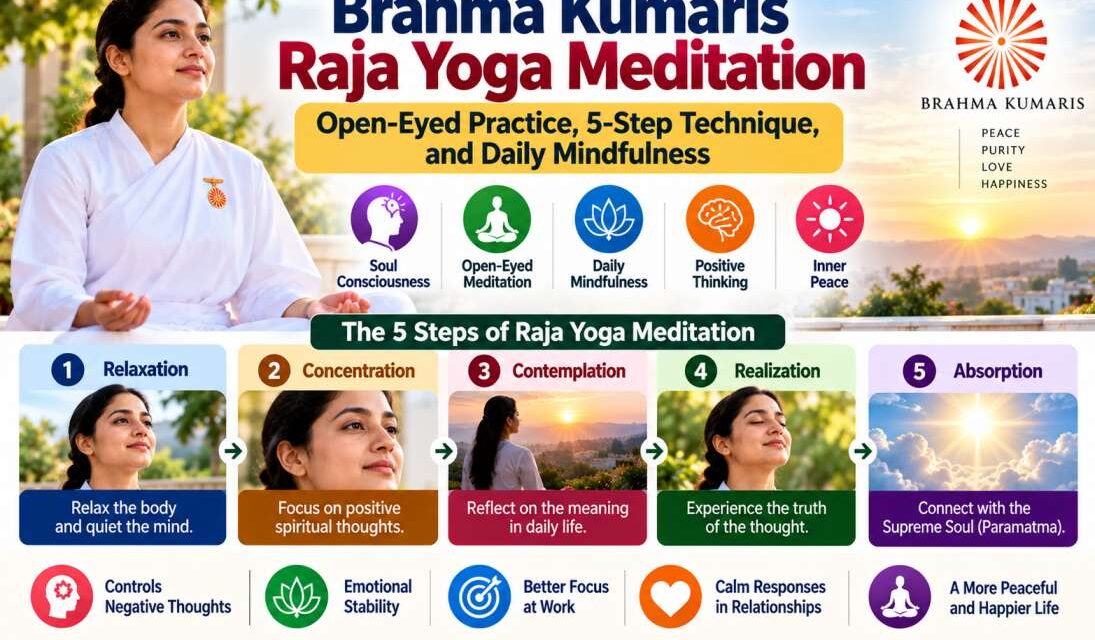
Do you want a calmer mind without sitting for long periods with your eyes closed? Brahma Kumaris Raja Yoga meditation offers a different approach. You learn to guide your thoughts, remember your inner nature, and stay aware of peace during daily tasks.
The Brahma Kumaris teach that the self is an eternal soul, distinct from the physical body. Their meditation method focuses on soul-consciousness, positive thoughts, and a connection with the Supreme Soul, or Paramatma.
Unlike some meditation styles, Raja Yoga is practised with the eyes open. This lets you bring meditation into ordinary moments, such as working, walking, eating, and speaking with others. (Official Brahma Kumaris meditation guide)
This guide explains the five steps of Raja Yoga meditation, the meaning of soul-consciousness, one-minute Traffic Control breaks, and the eight spiritual powers.
What Is Brahma Kumaris Raja Yoga Meditation?
Raja Yoga is a spiritual meditation practice taught by the Brahma Kumaris. It focuses on understanding the self, directing thoughts, and building a relationship with God through remembrance.
The practice does not require a fixed posture, ritual, or spoken mantra. You can sit comfortably, keep your eyes open, and guide your thoughts towards peace and spiritual awareness. (Brahma Kumaris Raja Yoga)
The aim is to move from automatic reactions to conscious choices. Instead of letting anger, worry, or fear guide every response, you pause and choose a thought or action that fits your values.
The Core Principle: Soul-Consciousness vs. Body-Consciousness
In Brahma Kumaris teachings, soul-consciousness means recognising yourself as a soul rather than defining yourself only by your body, name, job, age, or social role.
The soul, called Atma, is described as a non-physical point of conscious light located at the centre of the forehead. The body is seen as the physical form through which the soul expresses thoughts and actions.
Body-consciousness means giving too much weight to physical identity and external roles. For example, a person may think, “I am a failure,” after a mistake at work. Soul-consciousness encourages a different response: “I made a mistake, but I can learn and choose my next action.”
Within this spiritual framework, the soul has original qualities such as peace, love, purity, and happiness.
You can explore this idea through a simple reflection:
- I am more than my job or social role.
- I can observe my thoughts without acting on each one.
- I can choose how I respond to a difficult moment.
- I can practise peace even when my surroundings feel busy.
These ideas form part of the Brahma Kumaris spiritual worldview. They offer a way to reflect on identity and behaviour, not a scientifically verified account of consciousness.
Meditation Without Rituals: Why Open-Eyes Practice Matters
Many meditation styles ask you to close your eyes and turn your attention inward. Brahma Kumaris Raja Yoga takes another route.
You keep your eyes open, with a soft and relaxed gaze. You remain aware of the room and your surroundings, but your main attention rests on your thoughts and inner state.
This is useful when you want to practise during daily life. You can take a short pause at your desk, before a meeting, or during a quiet walk.
Open-eyed practice does not require you to ignore your surroundings. Keep your attention on safety when crossing roads, driving, using machinery, or doing other tasks that need full focus.
The aim is to develop a steady inner attitude that can carry into daily activity.
Masterclass: The 5 Easy Steps of Raja Yoga Meditation
The following five-step routine gives beginners a clear way to practise. It uses relaxation, concentration, contemplation, realization, and absorption as a practical guide.
The Brahma Kumaris’ wider Raja Yoga course includes spiritual study, reflection, application, and the development of positive qualities. Local courses may teach the process in different stages.
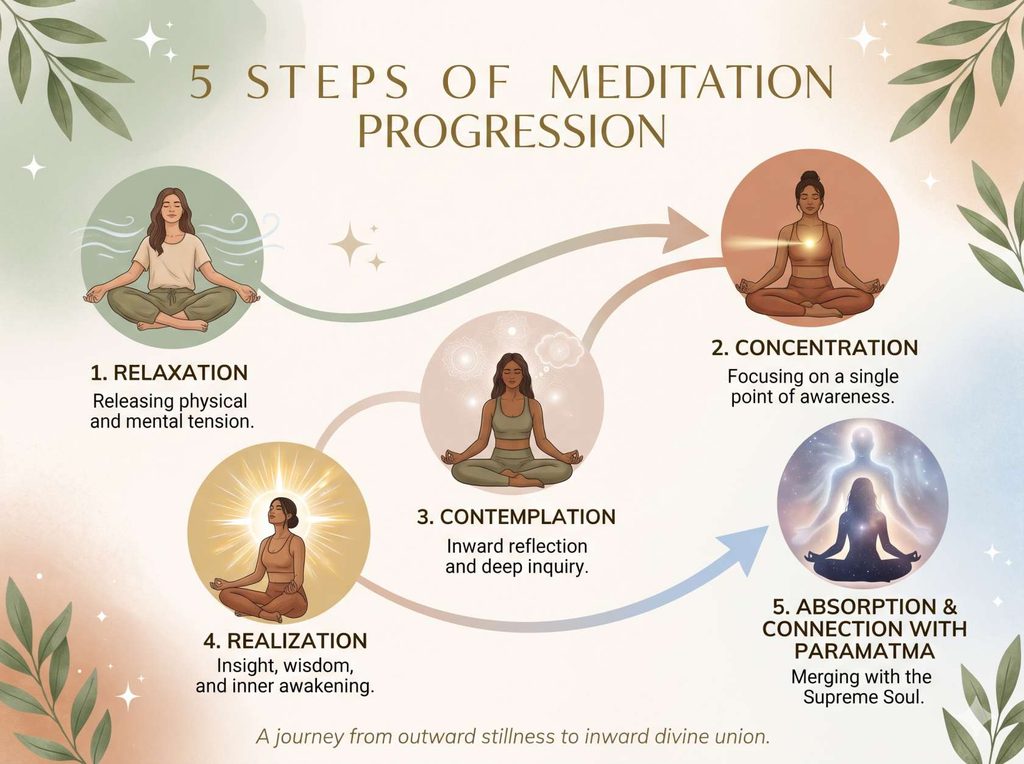
Step 1: Relaxation
Choose a comfortable chair or sit in a relaxed position. Keep your eyes open and let your gaze rest gently on one spot.
Relax your shoulders, hands, face, and jaw. Let your breathing return to its natural rhythm.
You do not need to force your mind to become empty. Simply notice your thoughts and give yourself a moment to pause.
Start with one or two minutes. A short, regular practice is a good way to begin.
Step 2: Concentration
Next, bring your attention to one clear idea.
In the Brahma Kumaris tradition, a common starting point is the thought, “I am a peaceful soul.”
Read the words slowly in your mind. Notice their meaning rather than repeating them without thought.
When your attention wanders, return to the idea. You do not need to criticise yourself for losing focus.
Concentration grows through repeated practice. Even a few moments of focused thought can help you become more aware of your inner state.
Step 3: Contemplation
Contemplation means thinking about a spiritual idea and exploring what it means in daily life.
Choose one thought, such as “I am a peaceful soul,” and reflect on it.
Ask yourself:
- What does peace mean to me?
- Can I stay calm when someone disagrees with me?
- How might I respond differently to a stressful situation?
- Can I bring this thought into my next task?
The aim is to move beyond reading a positive statement. You reflect on its meaning and how it may shape your choices.
Step 4: Realization
In this step, let the thought become a personal experience rather than an idea you only understand in words.
For example, think about peace and notice whether you can feel a little more settled. Remember a time you responded to a problem with patience. Consider how you might bring that quality into the present moment.
In Brahma Kumaris teaching, this is linked with experiencing the soul’s original qualities.
Do not force a special sensation or expect an instant change. Some sessions may feel calm; others may feel ordinary. Give yourself time to practise.
Step 5: Absorption and Connection with Paramatma
The final step focuses on remaining with the experience of peace and, within Brahma Kumaris belief, connecting with the Supreme Soul, Paramatma.
The tradition describes God as the Supreme Soul and the source of spiritual qualities such as peace and love.
You may reflect on a relationship with this source through quiet remembrance. Stay with the thought gently, without strain.
When your attention drifts, return to your chosen idea. Finish the session by carrying one positive intention into your next activity.
You might choose patience during a meeting, kindness in a conversation, or calm attention during a task.
This five-step routine is a beginner-friendly framework. For the full method and its spiritual meaning, the Brahma Kumaris recommend learning through their Raja Yoga meditation course.
Integrating Meditation Into Daily Life: Traffic Control
Raja Yoga is not limited to a morning session. The Brahma Kumaris encourage practitioners to recall their spiritual awareness throughout the day.
One practice is called Traffic Control. It involves pausing for one minute every hour to step back from activity and return attention to peace.
Taking One-Minute Mental Pauses During the Day
A busy day can fill the mind with tasks, messages, deadlines, and worries. A short pause gives you a chance to notice what you are thinking before you react.
Try this one-minute routine:
First 15 seconds: Pause your current task when it is safe to do so. Relax your shoulders and face.
Next 15 seconds: Notice your thoughts. Ask whether they are helping you act clearly or adding more worry.
Next 15 seconds: Reflect on the thought, “I am a peaceful soul.” Let the idea settle.
Final 15 seconds: Choose one calm, useful action for the next part of your day.
You can set a gentle hourly reminder on your phone or computer. Avoid doing this pause during tasks that need uninterrupted attention, such as driving or operating equipment.
The Brahma Kumaris describe Traffic Control as a way to break up busy thought patterns and return to a peaceful state.
Bringing Soul-Consciousness to Work, Food, and Relationships
Small moments can become reminders to practise awareness.
At work: Before answering a tense email, pause and choose your words with care. Try to respond to the issue rather than react to the emotion.
During meals: Eat without rushing when you can. Notice the food, the effort behind it, and your body’s signals of hunger and fullness.
In relationships: Listen before deciding what the other person means. Try to see the person beyond the disagreement.
During stress: Take a short pause and name what you are feeling. Choose your next action instead of acting on the first impulse.
Before sleep: Review the day without harsh self-judgment. Notice one thing you handled well and one thing you might approach differently tomorrow.
These habits may help you become more aware of your reactions and choices. They are not a promise that meditation will remove every negative thought or solve every problem.
The Eight Spiritual Powers of Raja Yoga
The Brahma Kumaris teach eight inner powers that can help people respond to daily situations with greater awareness.
The official list includes the Power to Withdraw, Pack Up, Tolerate, Accommodate, Face, Discriminate, Judge, and Co-operate. (Brahma Kumaris: The Eight Powers)
1. Power to Withdraw
The ability to step back from a situation and return to inner stillness before reacting.
2. Power to Pack Up
The ability to stop carrying an old problem or upsetting event into the rest of the day.
3. Power to Tolerate
The ability to remain steady when facing discomfort, delays, or another person’s difficult behaviour.
4. Power to Accommodate
The ability to make room for differences and consider another person’s point of view.
5. Power to Face
The ability to meet a difficult situation with courage rather than avoid it.
6. Power to Discriminate
The ability to see what is true, useful, and suitable instead of following every thought or impression.
7. Power to Judge
The ability to assess a situation and choose a suitable response at the right time.
8. Power to Co-operate
The ability to support others and work towards a shared goal.
These powers are part of the Brahma Kumaris spiritual model. You can use them as prompts for reflection: withdraw before reacting, tolerate a delay, accommodate a difference, or face a problem you have been avoiding.
The aim is not to suppress feelings or accept harmful behaviour. Calm judgment can include setting boundaries, asking for help, or taking action when needed.
Frequently Asked Questions
How Do You Practise Brahma Kumaris Raja Yoga Meditation with Open Eyes?
Sit comfortably, keep your eyes open, relax your body, and focus on a spiritual thought such as “I am a peaceful soul.” Reflect on the thought, notice its meaning, and return to it whenever your attention wanders.
What Are the Five Steps of Brahma Kumaris Meditation?
This guide uses five steps: relaxation, concentration, contemplation, realization, and absorption. The wider Brahma Kumaris course includes spiritual understanding, reflection, application, and the experience of positive qualities.
Can You Practise Raja Yoga Meditation at Work?
Yes, you can take brief pauses during the day when it is safe to do so. Traffic Control encourages one minute of reflection each hour. Keep full attention on tasks that need your immediate focus.
What Is Soul-Consciousness?
In Brahma Kumaris teaching, soul-consciousness means viewing yourself as an eternal soul rather than defining yourself only through the body, name, role, or status.
What Are the Eight Spiritual Powers?
They are the Powers to Withdraw, Pack Up, Tolerate, Accommodate, Face, Discriminate, Judge, and Co-operate. The tradition presents them as inner strengths for handling different situations.
Final Thoughts: Make Raja Yoga Part of Your Daily Routine
Brahma Kumaris Raja Yoga meditation offers a practical way to bring spiritual reflection into daily life. Its open-eyed method lets you practise at home, at work, or during a quiet pause between tasks.
Start with a few minutes each morning. Focus on one positive thought, reflect on its meaning, and choose one way to apply it during the day. Use one-minute Traffic Control pauses to return to that intention.
The five-step routine can help you learn the practice, and the eight spiritual powers offer prompts for handling daily challenges. With steady practice, you can become more aware of your thoughts and choose your responses with greater care.
For direct guidance, visit the official Brahma Kumaris website to find a Raja Yoga meditation course or a local centre.
