
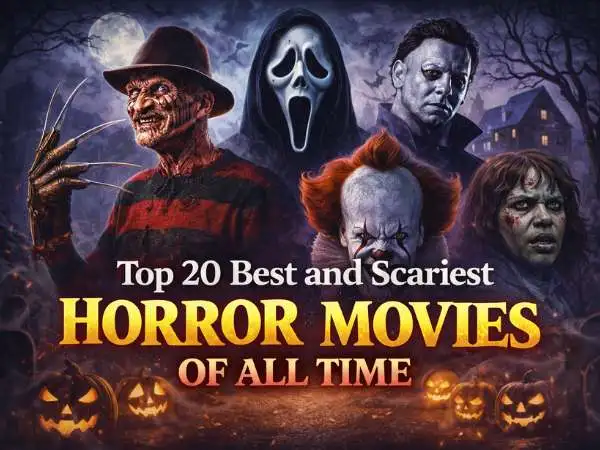
Horror doesn’t age like other genres.
Comedy changes. Action escalates. Visual effects improve.
But fear? Fear is primal. And the best and scariest horror movies of all time don’t just rely on special effects. They rely on atmosphere, silence, tension, and something harder to define — dread.
Some of the films below terrified audiences decades ago and still feel sharp today. Others are modern entries that reshaped what horror looks like now.
These aren’t just popular horror movies.
They’re the ones that stay with you.
1. The Exorcist (1973)
When The Exorcist premiered, it didn’t just scare people — it unsettled them deeply. Reports of fainting, vomiting, and walkouts weren’t exaggerated marketing myths. The film struck something raw.
What makes it endure isn’t just the possession imagery. It’s the build-up. The slow deterioration of a mother watching her child change. The medical tests that offer no answers. The creeping sense that something ancient has entered a modern home.
The horror works because it feels grounded. The house looks ordinary. The mother feels believable. The priests feel human.
And when the supernatural breaks through that realism, it hits harder.
It still does.
Also Read : – Knight of Cups Movie: Meaning, Plot, Cast, and Why This Film Refuses to Be Explained Easily
2. The Shining (1980)
The Shining isn’t loud horror. It’s controlled psychological decay.
Stanley Kubrick turns isolation into a character. The Overlook Hotel feels vast and empty at the same time. Hallways stretch longer than they should. Rooms feel too symmetrical. Silence lingers too long.
Jack Torrance doesn’t snap suddenly. He erodes. And that slow erosion is what makes the performance unsettling.
The famous images — the twins, the elevator of blood, the axe through the door — are iconic. But the deeper fear comes from watching a family dissolve in isolation.
It’s cold. Calculated. And still disturbing.
3. Hereditary (2018)
Modern horror rarely feels this relentless.
Hereditary begins as a story about grief. A family coping with loss. But grief mutates into something darker.
Toni Collette delivers one of the most emotionally raw performances in horror history. Her breakdown scenes don’t feel cinematic. They feel invasive.
The film builds unease quietly. Strange background details. Subtle visual clues. Silence stretching too long.
Then it delivers moments that are shocking not because they’re loud — but because they feel irreversible.
It doesn’t want you comfortable. And it succeeds.
4. Halloween (1978)
Sometimes horror works because of what doesn’t happen.
Michael Myers barely speaks. He doesn’t monologue. He doesn’t explain. He simply appears.
John Carpenter’s minimalist score drives the tension. The camera lingers behind bushes. Across streets. Through windows.
You feel watched before the characters do.
That stalking presence is what made Halloween revolutionary. It stripped horror down to movement, mask, and patience.
And patience can be terrifying.
Also Read : – Twilight Saga Movie Order: The Complete Way to Watch the Series Without Missing Anything
5. Get Out (2017)
Get Out changed the conversation around horror.
Jordan Peele blended social tension with psychological dread. The horror isn’t immediate. It creeps in through politeness, through awkward pauses, through conversations that feel slightly off.
The “Sunken Place” scene is one of the most haunting visual metaphors in modern horror. Not because it’s graphic — but because it’s isolating.
It’s horror rooted in control. In manipulation. In the loss of agency.
And that kind of fear feels very real.
6. The Texas Chain Saw Massacre (1974)
Dirty. Chaotic. Almost documentary-like.
The Texas Chain Saw Massacre doesn’t rely on polished cinematography. It feels grimy. Sweaty. Immediate.
The dinner table scene alone is suffocating. You don’t feel like you’re watching something staged. You feel trapped inside it.
Leatherface became a horror icon, but the film’s real power lies in its atmosphere — heat, isolation, panic.
It feels raw in a way few modern horror films attempt.
7. The Silence of the Lambs (1991)
Technically categorized as a thriller, but emotionally pure horror.
Anthony Hopkins’ Hannibal Lecter doesn’t move much. He doesn’t shout. He speaks calmly.
And that calm delivery makes him terrifying.
The close-up shots during conversations feel invasive. You feel examined.
The film proves that psychological horror doesn’t require supernatural elements. It only requires intelligence paired with cruelty.
Also Read : – Movies With Vince Vaughn: A Full Look at His Best Films, Comedy Roles, TV Shows, and Career Evolution
8. The Babadook (2014)
Grief manifests physically in The Babadook.
The monster isn’t just a creature. It’s unresolved trauma.
The film uses minimal jump scares. Instead, it builds tension through repetition — the knocking, the whispering, the book that won’t stay closed.
It’s horror that feels intimate.
Uncomfortably so.
9. Alien (1979)
Science fiction and horror collide perfectly here.
The spaceship Nostromo feels claustrophobic. Industrial. Cold.
The creature design remains one of the most disturbing in film history. The chestburster scene still shocks new audiences.
But the film’s power lies in pacing. Long stretches of quiet before violence.
Space feels endless — yet suffocating.
10. Midsommar (2019)
Daylight horror feels wrong.
Midsommar takes place mostly under bright skies. There are no shadows to hide in. Every disturbing ritual happens in full view.
The film blends beauty and brutality. Floral crowns. White dresses. Smiling faces.
The contrast creates unease.
It’s not about jump scares. It’s about watching something terrible unfold in plain sight.
11. Psycho (1960)
Before modern horror found its rhythm, Alfred Hitchcock rewrote the rulebook.
Psycho doesn’t open like a horror movie. It feels like a crime drama. A woman steals money. She’s on the run. You follow her perspective. You expect her to remain central.
And then the shower scene happens.
It’s still shocking today — not because of gore, but because of structure. Killing off the apparent lead halfway through the film was almost unheard of in 1960. Audiences were forced into uncertainty.
Anthony Perkins’ Norman Bates remains one of horror’s most psychologically layered characters. He isn’t loud. He isn’t physically imposing. He feels polite. Soft-spoken. Slightly awkward.
That normality is what makes him dangerous.
The black-and-white cinematography adds stark contrast, making shadows feel heavier. The screeching violin score still pierces.
Psycho proves that suggestion is often scarier than spectacle.
Also Read : – Actors in Suits: Complete Cast Guide From Season 1 to Season 9
12. The Ring (2002)
In the early 2000s, technology became part of daily life in a new way. VHS tapes were fading. Televisions felt domestic, safe.
The Ring turned those objects into threats.
The cursed videotape concept is simple: watch it, and you die in seven days. But the real tension comes from atmosphere. The color palette is drained — blues and greys dominate. Everything feels damp and cold.
The pacing is patient. The film builds unease through investigation. The mystery unfolds gradually. And then the television scene happens.
When Samara crawls out of the screen, the barrier between media and reality collapses.
That image still lingers.
13. The Blair Witch Project (1999)
Few films benefited from timing like The Blair Witch Project.
In 1999, internet marketing was new. The film blurred fiction and reality, convincing many viewers the footage was authentic.
The shaky camera work felt raw. The performances felt unscripted. The woods felt endless.
What makes it powerful is what you don’t see. The witch is never clearly shown. The fear builds through sound — snapping twigs, distant screams, disorientation.
The final scene, with one character standing silently in a corner, remains deeply unsettling.
Minimalism works here.
14. The Descent (2005)
Before the monsters even appear, The Descent suffocates you.
A group of women explore an uncharted cave system. The tunnels narrow. Headlamps flicker. Rocks shift. Panic builds.
The claustrophobia alone feels unbearable.
When the creatures finally emerge, the film doesn’t become chaotic. It becomes survival horror. The darkness hides movement. The sound design amplifies breathing and scraping stone.
The combination of physical confinement and predatory threat makes this one of the most intense horror experiences of the 2000s.
It’s relentless.
Also Read : – Fifty Shades of Grey, The Cast That Carried a Global Phenomenon, and Where Their Careers Went After the Film
15. The Witch (2015)
Set in 1630s New England, The Witch feels stripped down and cold.
A family is exiled to live near the woods. Crops fail. Livestock dies. Suspicion grows.
The dialogue feels old and formal, which adds to the isolation. The pacing is slow. Silence stretches.
The horror builds through paranoia. Family members turn against each other. Faith becomes fragile.
By the time the supernatural becomes undeniable, the emotional damage is already done.
It’s quiet horror — but heavy.
16. Midsommar (2019)
Horror usually hides in shadows.
Midsommar unfolds almost entirely in sunlight.
The brightness is disorienting. White clothing. Open fields. Floral crowns. It feels festive at first.
Then the rituals begin.
The film blends heartbreak with cultural horror. Florence Pugh’s performance anchors the emotional weight. You watch her process betrayal and grief in a foreign environment that slowly becomes threatening.
The contrast between beauty and brutality creates unease.
Nothing is hidden.
That’s what makes it worse.
17. The Omen (1976)
Religious horror often leans dramatic.
The Omen leans inevitable.
A child may be the Antichrist. The adults slowly realize it. Strange deaths occur. Warnings appear.
The film builds dread through inevitability rather than chaos.
Damien doesn’t need to speak much. His presence creates tension.
It feels ominous in a classical way — structured, controlled, serious.
18. Scream (1996)
By the mid-90s, horror had grown predictable.
Scream acknowledged that — and then weaponized it.
Characters discuss horror rules while living inside one. The self-awareness doesn’t weaken the scares. It sharpens them.
The opening scene alone remains iconic. The phone call. The tension. The unexpected outcome.
Ghostface became a cultural staple, but the film’s success lies in its balance of humor and real suspense.
Meta, but effective.
Also Read : – FUBAR Cast: Meet the Stars of Netflix’s Action-Packed Series
19. It Follows (2014)
The horror in It Follows doesn’t run.
It walks.
An entity slowly approaches its victim. It can look like anyone. It never stops.
The wide camera shots create tension. You scan the background constantly, unsure who is real and who isn’t.
The pace is deliberate. The soundtrack feels retro yet uneasy.
The inevitability creates paranoia.
You can’t outrun it forever.
20. The Conjuring (2013)
Modern haunted-house horror often leans into spectacle.
The Conjuring leans into pacing.
The farmhouse setting feels isolated but grounded. The performances make the supernatural events believable.
The “clap” scene remains one of the most effective modern horror sequences. It builds tension through anticipation.
The film respects silence.
And silence builds fear.
Why These Are the Best and Scariest Horror Movies of All Time
What unites these films isn’t gore or budget.
It’s atmosphere.
The best horror films don’t rely on constant noise. They build tension slowly. They let silence linger. They trust the audience to feel discomfort.
And that discomfort sticks.
Fear that lingers is stronger than fear that explodes.
Also Read : – The Art of IPTV: Crafting Your Perfect Viewing Experience in the UK
Final Words
The best and scariest horror movies of all time aren’t just frightening in the moment.
They stay with you.
They make quiet rooms feel different. They make ordinary spaces feel slightly unsafe. They turn everyday environments into something uncertain.
That’s the power of horror done well.
Not spectacle.
Sustained unease.
FAQ
What is considered the scariest horror movie ever made?
The Exorcist is frequently cited due to its lasting cultural impact and disturbing realism.
What is the best modern horror movie?
Hereditary, Get Out, and Midsommar are often considered modern classics.
Are older horror movies still scary?
Yes. Atmosphere-driven films like The Shining and Psycho still unsettle audiences today.
What makes a horror movie truly scary?
Strong atmosphere, psychological tension, and emotional stakes tend to create lasting fear.
